Explainer · Global economy & Fed

Does CPI measure your inflation? What the CPI number really counts

11 Nov 2026 · EN

Every month the US Bureau of Labor Statistics records the prices of about 80,000 items and turns them into one number, the Consumer Price Index. In the report released on 10 Nov 2026, the CPI rose 0.4% in October (seasonally adjusted). The bureau itself says a national average seldom mirrors any one person's experience.

Key points

  • There is no 12-month CPI figure for October 2026: BLS did not collect October 2025 prices because of the 2025 lapse in appropriations.
  • Each item counts by how much households spend on it, and BLS updates the weights every year. Shelter is the biggest piece, about 35.6% of the index (December 2025), followed by food at about 13.7%, medical care services at about 6.9% and energy at about 6.4%.
  • For homeowners, the CPI does not count mortgage interest or house prices: buying a home is treated as an investment. Instead it estimates what the home would rent for (owners' equivalent rent), about 26% of the index.
  • The CPI-U covers urban households, over 90% of the US population. One way to read it: renters, commuters and homeowners each carry a different basket, so their own inflation can differ from the average.
  • Slower inflation doesn't mean lower prices: the CPI index is up about 30% from January 2020 to October 2026.

Sources

Educational · Not financial advice Made with AI tools (AI voices and visuals), checked by a person
More AI stock analysis

All videos →

Explainers

AI & technology · 10 Nov 2026

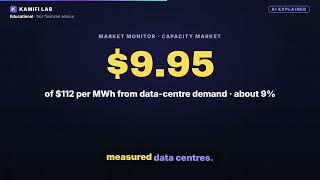
Is AI pushing up your power bill? Data centres, America's biggest grid and who pays

On PJM, America's biggest power grid, the total wholesale cost of power was about $112 per MWh in January–September 2026, up from about $79 in the same months of 2025 (+41%). The grid's independent market monitor estimates that data-centre demand added about $10 of that, through the capacity market only. How big a part data centres play in rising power costs is disputed.

World & economy · 9 Nov 2026

What do governments know? The risk lists behind "keep supplies at home"

95% of people in the EU say their country faces disaster risks, yet 58% don't feel well prepared (Eurobarometer 2024). Much of what governments plan for is published: Britain's 2026 National Risk Register scores 95 risks and sets out planning worst cases, not forecasts. Part 1 of 2.

World & economy · 9 Nov 2026

Could you last 72 hours at home? What governments do, and what you can do

Part 2 of 2. In a power cut a fridge keeps food cold for about 4 hours with the door shut, and a full freezer about 48 (UK Food Standards Agency, Ready.gov). This video answers four questions with official guidance only: what governments do first, what households can prepare, what to do during the event, and what to do if it lasts a week.

Geopolitics & markets · 7 Nov 2026

Why governments want you to keep 72 hours of supplies

On 28 April 2025, Spain lost power equal to about 60% of its demand in roughly five seconds, and nearly all of it was back by 7 a.m. the next morning. On 3 November 2026 the European Commission presented guidelines so that households can cover their basic needs for at least 72 hours. Why are governments asking, and what does it mean for shops, spending and insurers?

Scams & risk · 6 Nov 2026

Pump-and-dump: how it works and the red flags

In a case announced by the US Justice Department in November 2025, prosecutors say people posing as financial advisers drew investors into WhatsApp chats, promised returns of 300–500% and steered them into one Nasdaq-listed stock. On 17 April 2024 its price collapsed about 88% in a single day. These are charges, not a conviction.

Investor psychology · 5 Nov 2026

FOMO: why people buy after the big jump

In January 2021, GameStop went from under $20 to a $347.51 close on 27 January (pre-split prices), then fell more than 86% from its 28 January intraday high of $483 in about a week. Why do people chase a stock after a big jump?